


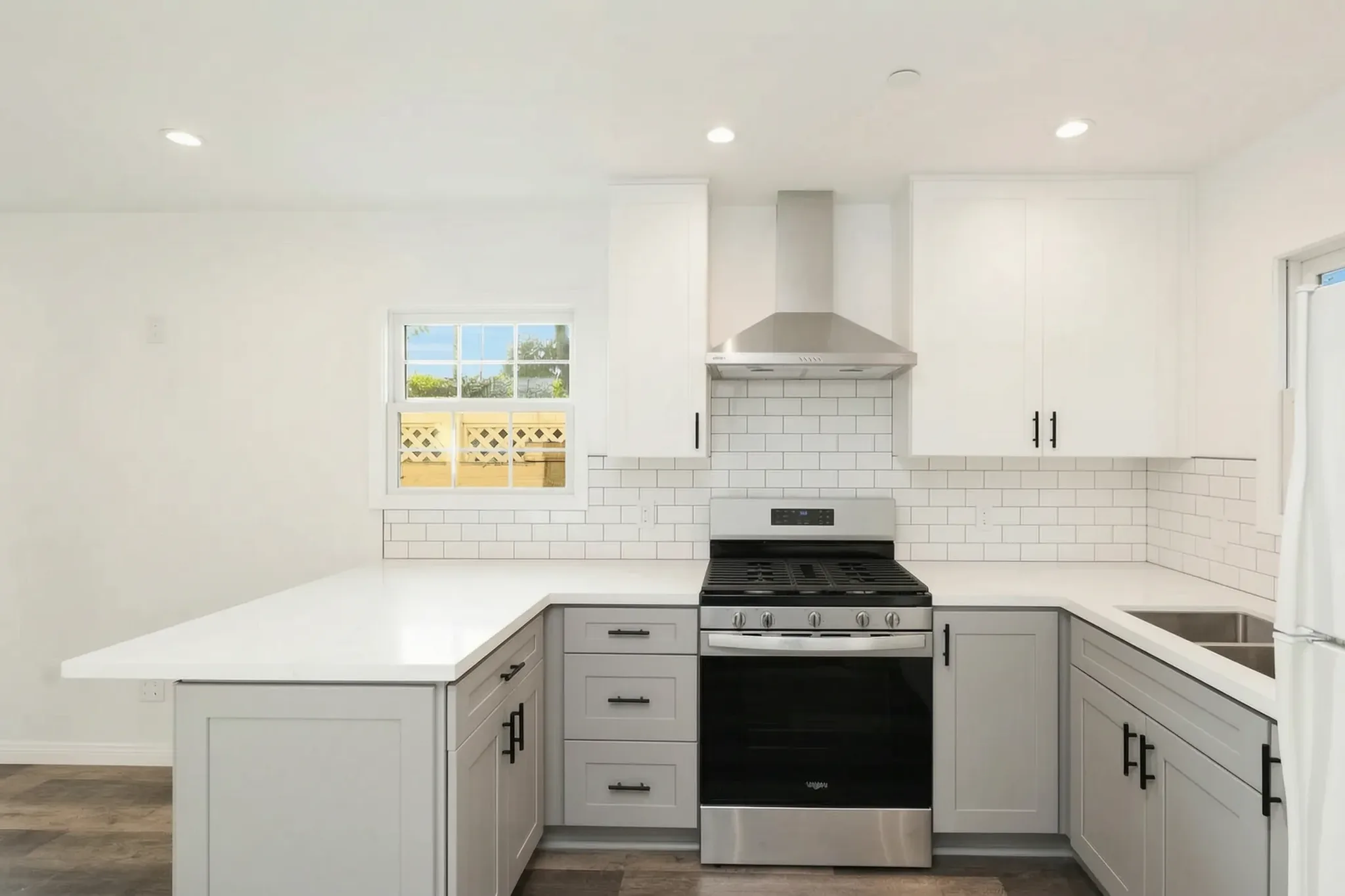
ADU basics · Orange County
Orange County, CaliforniaA Junior ADU is the smallest ADU: up to 500 square feet, inside the house you already have.
Inside the house you already have.
The ranges on this page are Avorino’s published Orange County figures, across the 37 cities we build in, under California General-B License #1107538. Every state rule is quoted from the Government Code sections linked at the foot of the page; the one city rule is quoted from Santa Ana’s own standards page.
The short answer
What is a Junior ADU (JADU)?
A Junior ADU, or JADU, is a second home built within the walls of an existing or proposed single-family house: California Government Code §66313(d) defines it as “a unit that is no more than 500 square feet of interior livable space in size and contained entirely within a single-family residence.” It must have its own entrance and an efficiency kitchen, and it may share a bathroom with the house. In Orange County, Avorino builds Junior ADUs at typically 300 – 500 sqft, for typically $135K – $220K+, over 4–6+ mo.
- Its own entrance
- An efficiency kitchen
- A bath of its own, or shared
What the law says
What the law says a Junior ADU is.
Two sentences carry the definition. The first is the size and the location: “no more than 500 square feet of interior livable space in size and contained entirely within a single-family residence” (§66313(d)). The second is the construction rule a city ordinance must apply: built “within the walls of the proposed or existing single-family residence” (§66333(d)). Nothing is added to the footprint, which is why its range sits where it does.
Run your numbersA Junior ADU, by the numbers
- Interior livable space, at most
- 500 sq ft
- · §66313(d)
- Typical cost
- $135K – $220K+
- Typical size
- 300 – 500 sqft
- Build window
- 4–6+ mo
- 01The room
- 02Drawings
- 03Permit
- 04The build
- 05Keys
The four ADU types (4)
JADU vs ADU, side by side.
The Junior ADU is one of four typologies California state ADU law recognizes. Here it sits beside the other three on size, cost and build window, all four read from the same published Orange County figures.

01 Junior ADU (JADU)
Conversion within the existing footprint. Tightest scope, kitchenette + bedroom only.
- 300 – 500 sqft
- $135K – $220K+
- 4–6+ mo

02 Detached ADU
Standalone unit on your property. Most rental upside, longest schedule, biggest ROI when the property has the room.
- 500 – 1,200 sqft
- $245K – $440K+
- 5–8+ mo

03 Attached ADU
Addition off the primary residence. Shares a wall, often shares a service line.
- 450 – 1,000 sqft
- $200K – $350K+
- 5–8+ mo

04 Garage conversion
Existing garage rebuilt as living space. Fastest move when the garage frame is sound.
- 350 – 600 sqft
- $85K – $170K+
- 4–6+ mo
Built by Avorino · Orange, California
Built against the house.
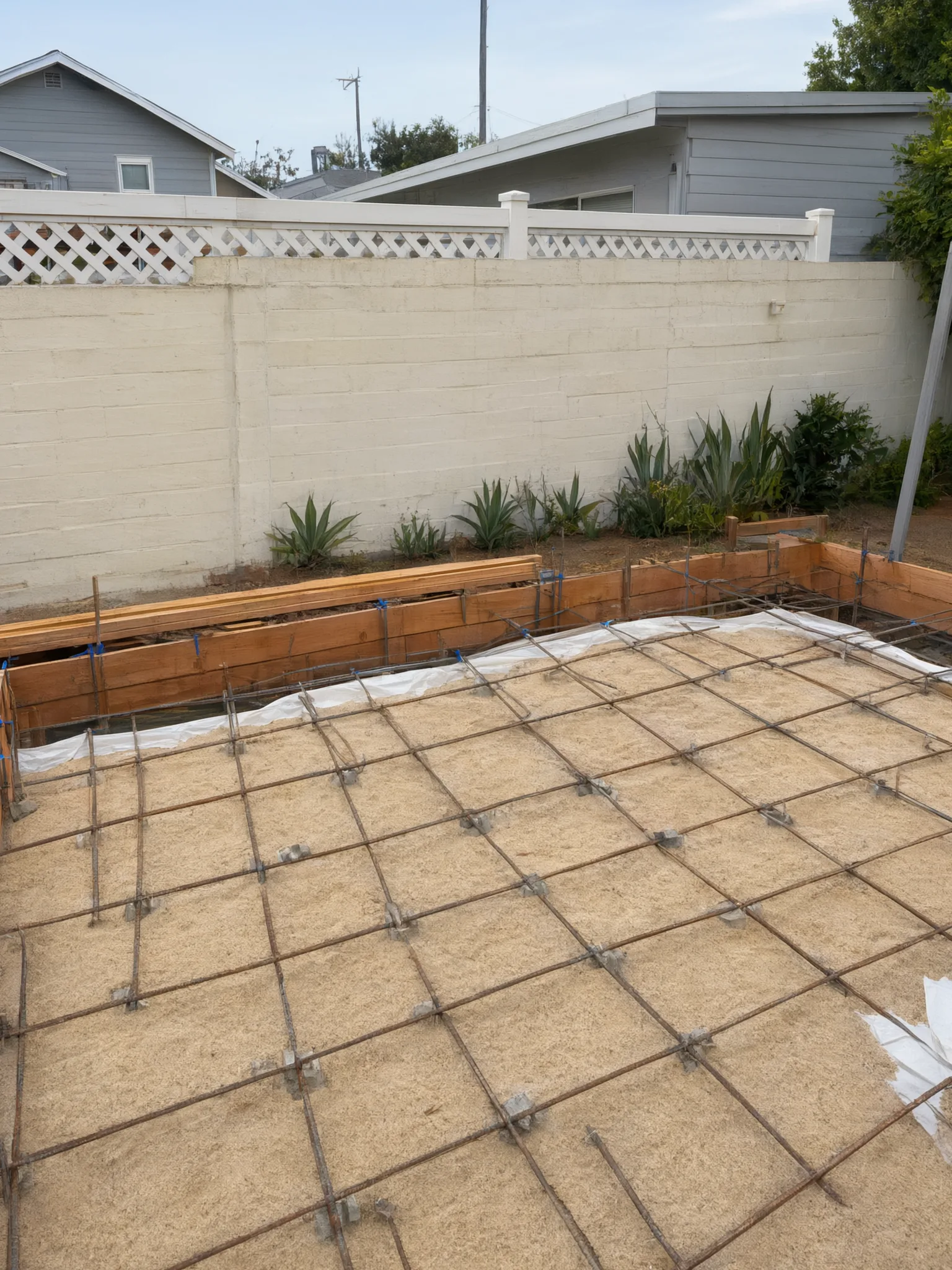
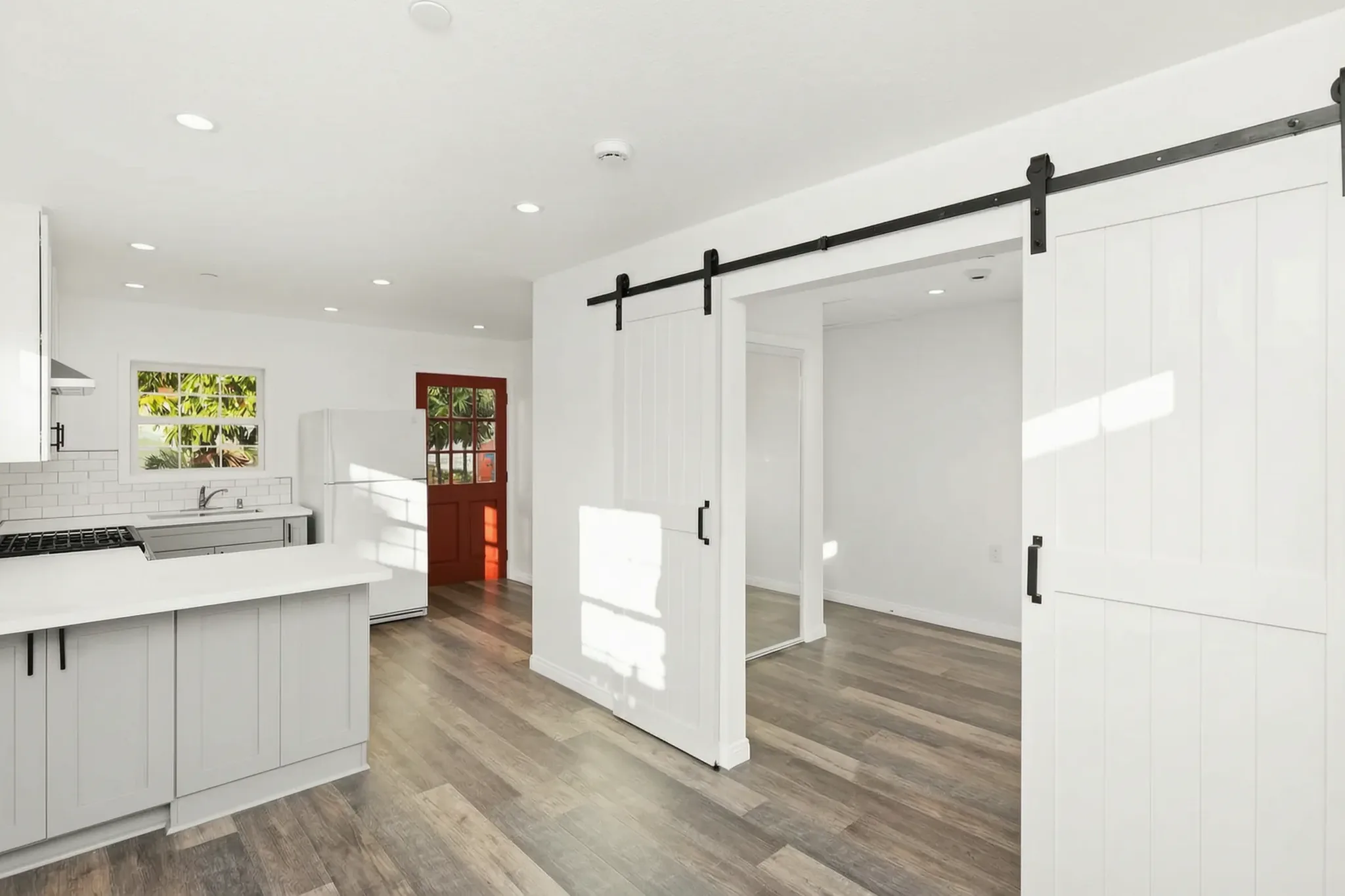
One attached ADU in Orange, followed on site from the slab rebar to the finished barn doors. It is an attached ADU, the Junior ADU's closest built relative on our books.
Slab rebar over the sand pad, inside the forms.
Built by Avorino · Orange, California
Built against the house.
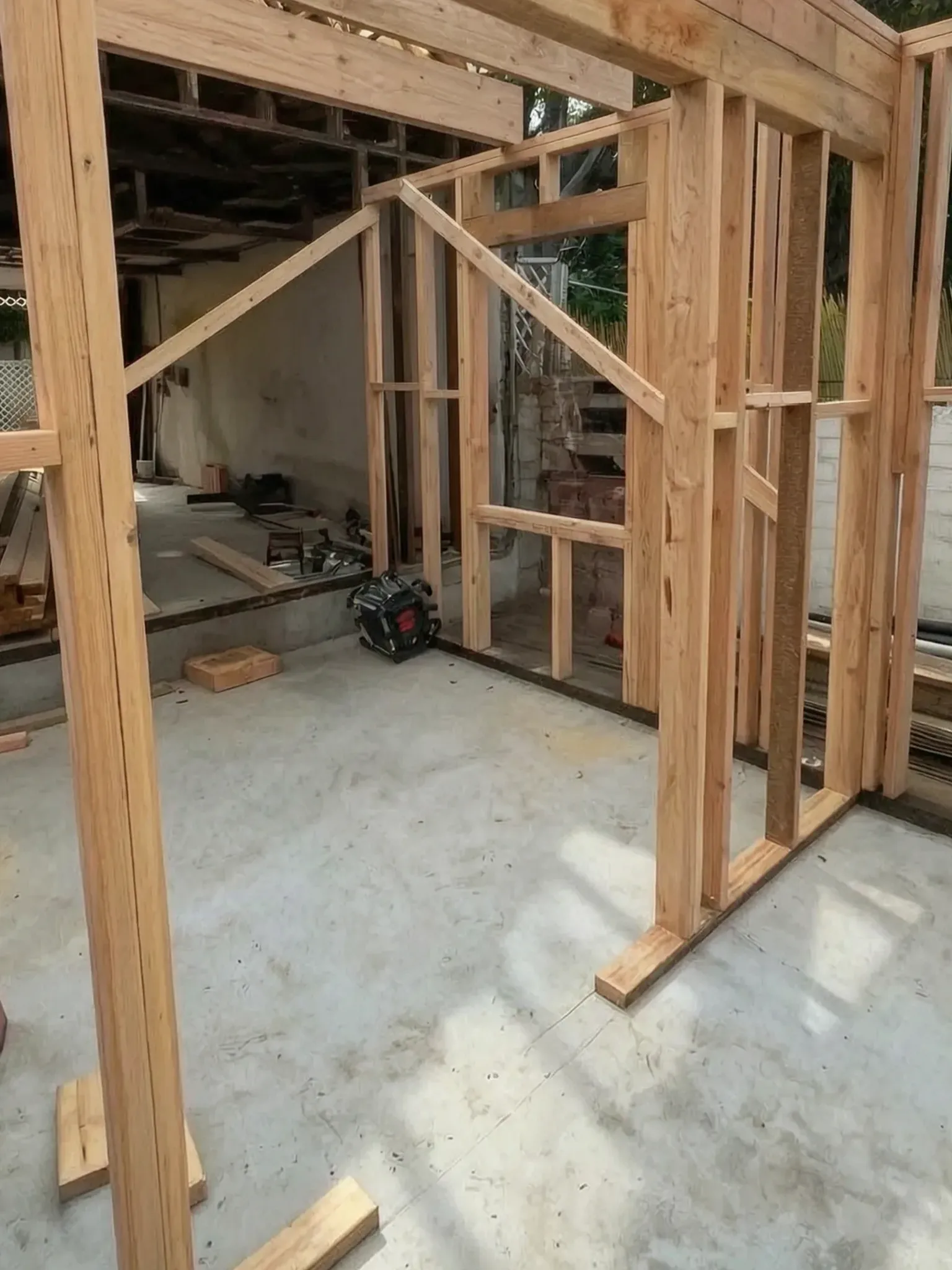
One attached ADU in Orange, followed on site from the slab rebar to the finished barn doors. It is an attached ADU, the Junior ADU's closest built relative on our books.
- 01 / 05
The slab
Slab rebar over the sand pad, inside the forms.
 02 / 05
First walls
The first wall framing and a header beam on the new slab.
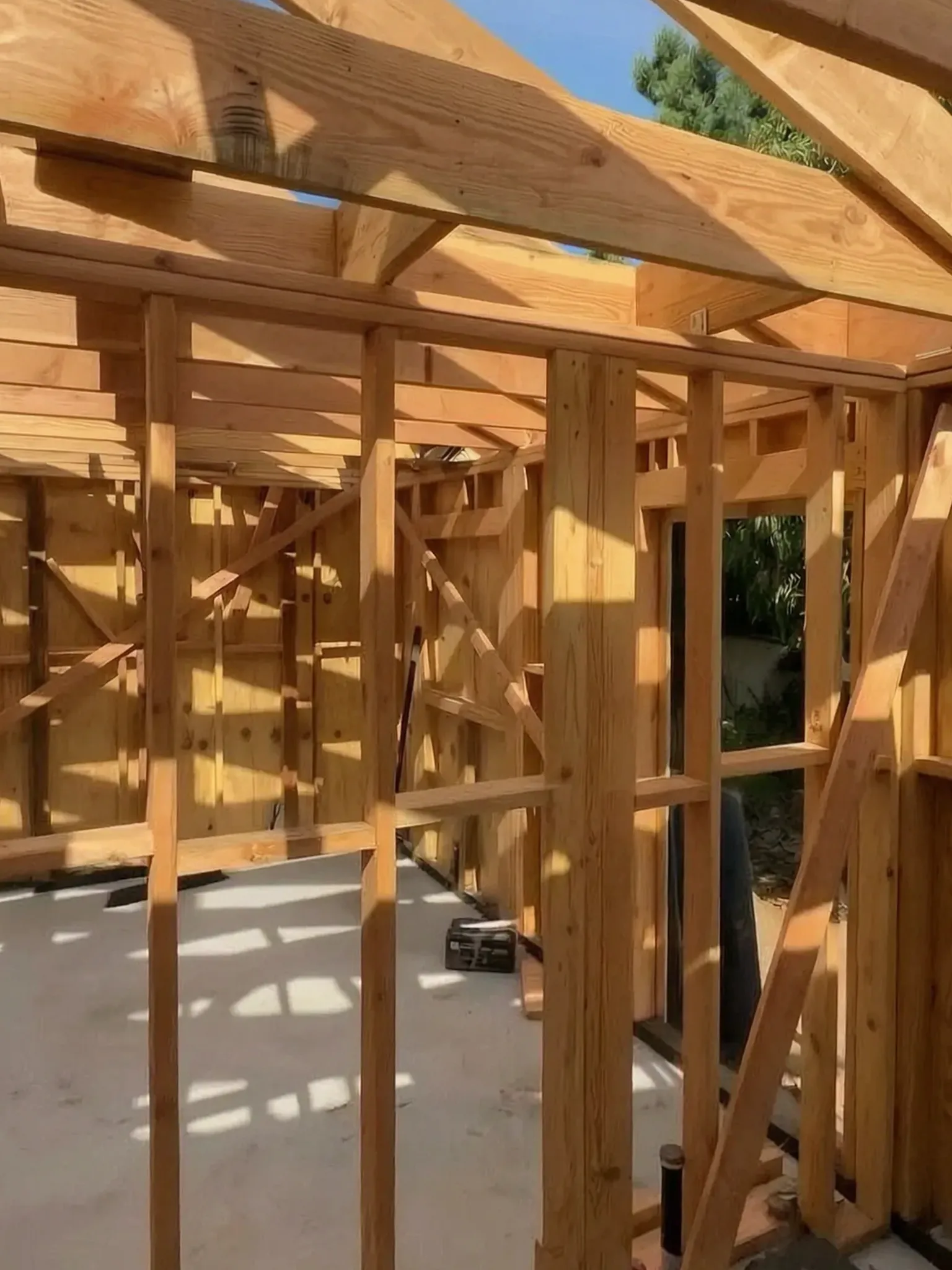 03 / 05
The roof
Wall framing and roof rafters against the sky.
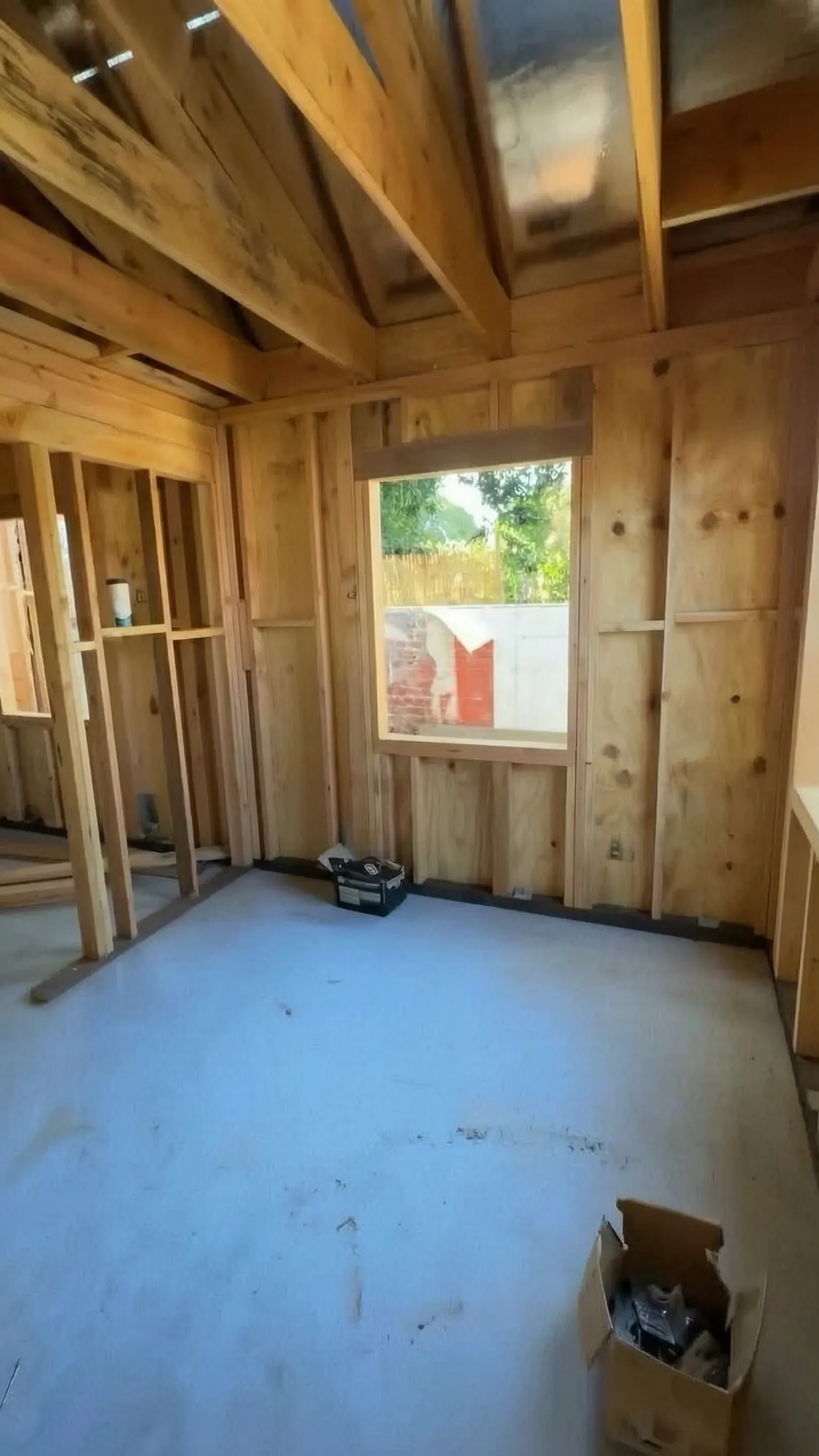 04 / 05
Sheathed
A sheathed wall with the framed window opening.
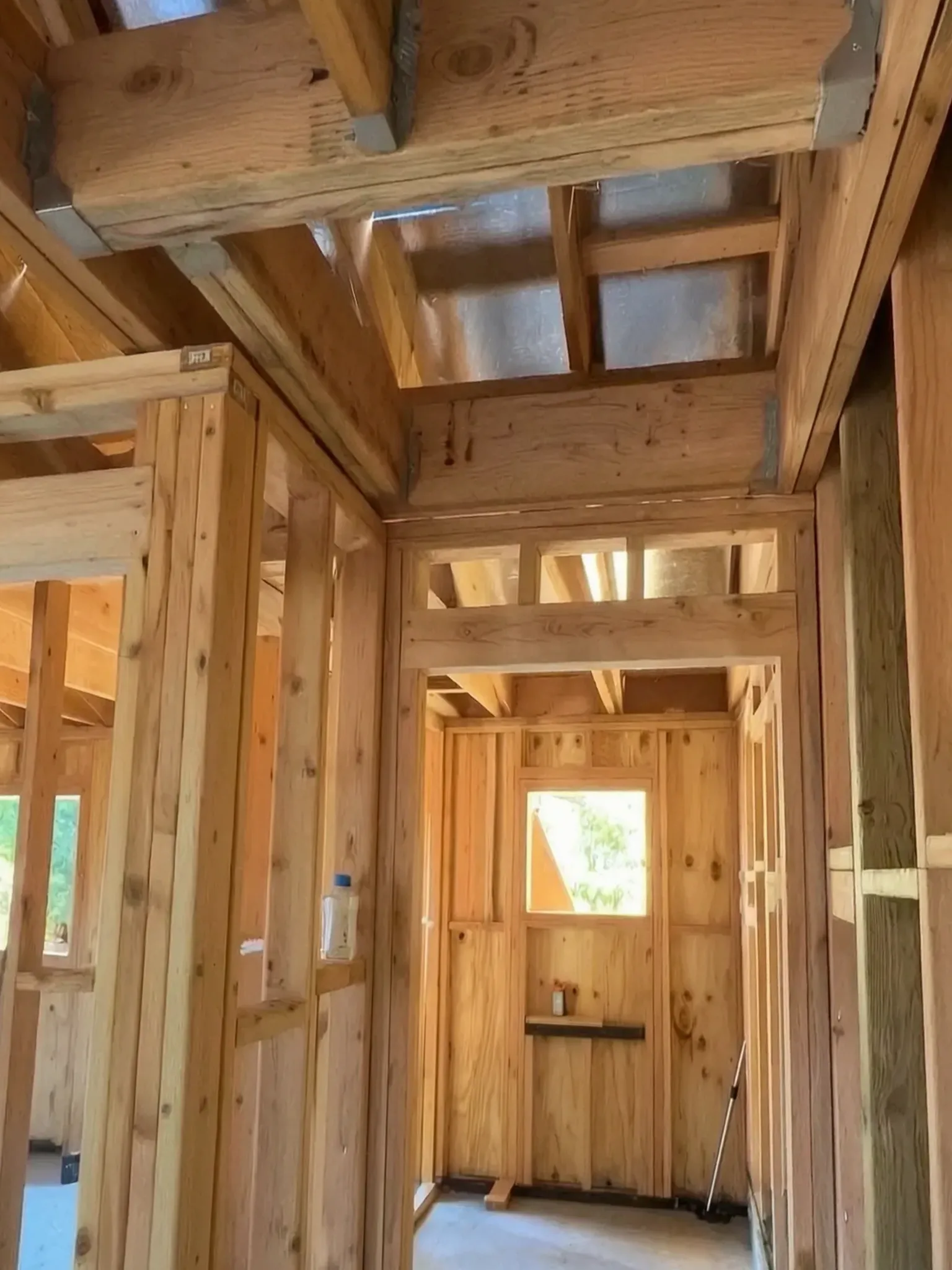 05 / 05
The hallway
A framed hallway with double headers and ceiling joists.
The permit path
From a spare room to a permitted unit.
Five steps, each tied to the rule that governs it.

01 / 05
Find the room to give.
500 sq ft
A bedroom, a den, an unused wing, or an attached garage that already sits inside the house's walls, rebuilt as a small self-contained unit. Nothing is added to the footprint, which is why it is the tightest-scope path of the four typologies.
The statute's cap on interior livable space (§66313(d))
02 / 05
Draw what it must include.
The drawings carry what the ordinance must require: an entrance of its own and an efficiency kitchen. The bathroom is the owner's choice, and that choice decides the owner-occupancy rule.
- A separate entrance (§66333(e)(1))
- An interior entry to the house when the bath is shared (§66333(e)(2))
- An efficiency kitchen (§66333(f))
- A bath of its own, or shared (§66313(d))
03 / 05
The city reviews the permit.
The state rules are the floor; each city writes its own ordinance on top of them and reviews the permit. Santa Ana, for one, records a restrictive covenant at permit time. The Orange County ADU permit index names how each of the 37 cities takes an application.
04 / 05
Built inside the walls.
4–6+ mo
No new foundation or exterior structure is involved, which is where the Junior ADU's range sits.
Typical build window · $135K – $220K+
05 / 05
Live in it, or rent it.
Rent it on terms longer than 30 days (§66333(g)), or keep it for family. A separate sale is prohibited by the recorded deed restriction (§66333(c)(1)).
The statute, section by section
Every rule, in the law's own words.
The owner-occupancy rule is narrower than most sites state, and it turns on the bathroom. Each row quotes its section; the sections are linked at the foot of the page.
Plan your ADU| Rule | What the statute says | Section |
|---|---|---|
| What it is | “a unit that is no more than 500 square feet of interior livable space in size and contained entirely within a single-family residence” | §66313(d) |
| Built inside the walls | “Require a permitted junior accessory dwelling unit to be constructed within the walls of the proposed or existing single-family residence” | §66333(d) |
| Its own entrance | “Require a permitted junior accessory dwelling unit to include a separate entrance from the main entrance to the proposed or existing single-family residence”; with no bath of its own it “shall include a separate entrance from the main entrance to the structure, with an interior entry to the main living area” | §66333(e)(1), (e)(2) |
| An efficiency kitchen | “A cooking facility with appliances” and “A food preparation counter and storage cabinets that are of reasonable size in relation to the size of the junior accessory dwelling unit” | §66333(f) |
| The bathroom | A Junior ADU “may include separate sanitation facilities, or may share sanitation facilities with the existing structure” | §66313(d) |
| Who has to live there | “If the junior accessory dwelling unit has shared sanitation facilities with the existing structure, require owner-occupancy in the single family residence in which the junior accessory dwelling unit will be permitted. The owner may reside in either the remaining portion of the structure or the newly created junior accessory dwelling unit. Owner-occupancy shall not be required if the junior accessory dwelling unit has separate sanitation facilities, or if the owner is another governmental agency, land trust, or housing organization.” | §66333(b) |
| The deed restriction | Recorded, and it “shall run with the land”: “A prohibition on the sale of the junior accessory dwelling unit separate from the sale of the single-family residence” and “A restriction on the size and attributes of the junior accessory dwelling unit that conforms with this article” | §66333(c) |
| Renting it | “Require that a rental of a junior accessory dwelling unit be for a term longer than 30 days” | §66333(g) |
| With a detached ADU | A city must “ministerially approve an application for a building permit” for “One accessory dwelling unit and one junior accessory dwelling unit per lot with a proposed or existing single-family dwelling” together with “One detached, new construction, accessory dwelling unit” | §66323(a)(1), (a)(2) |
| Fire sprinklers | “The installation of fire sprinklers shall not be required in an accessory dwelling unit or a junior accessory dwelling unit if sprinklers are not required for the primary residence.” | §66323(d) |
01
How Orange County cities handle it.
The state rules are the floor; each city writes its own ordinance on top of them and reviews the permit. Santa Ana’s published JADU standards are a fair picture: “Exterior access required, but interior access is optional. Interior access is required when JADU shares bath/sanitation facilities with the primary residence,” and “Owner occupancy is required in either the single-family residence or the JADU. A restrictive covenant will be recorded” at permit time, with rentals allowed “for periods of 30 days or more” (City of Santa Ana, ADU and JADU development standards). The Orange County ADU permit index names how each of the 37 cities takes an ADU application, and the Santa Ana ADU page carries that city’s process in full.
02
A Junior ADU and a detached ADU on the same lot.
This is the combination that makes the Junior ADU worth knowing about. The Junior ADU takes the spare bedroom; the detached ADU takes the yard; each has its own permit (§66323(a)(1) and (a)(2)), and neither needs fire sprinklers the house does not (§66323(d)). The detached ADU page carries the state standard set for the standalone unit.
03
Where a Junior ADU fits, and where it does not.
It fits when the house has a room to give and the goal is a small, low-cost rental or a place for a parent, and the yard is too tight for a detached unit or reserved for one later. It does not fit a plan that needs two bedrooms, a separate building, or more than the statute’s 500 square feet: that is a garage conversion at typically $85K – $170K+, or a detached ADU. Granny flat covers the family use, What is an ADU sets all four typologies side by side, the ADU cost estimator prices a build for your city, square footage and finish level in about a minute, and the ADU hub carries process, financing and the cities we build in.
Built by Avorino
ADUs we have built.
Completed Avorino ADUs, photographed as built. Every one permitted with its city.
01 / 08
01 / What it is
What is a Junior ADU (JADU)?
A Junior ADU is the smallest kind of accessory dwelling unit: California Government Code §66313(d) defines it as "a unit that is no more than 500 square feet of interior livable space in size and contained entirely within a single-family residence." It is built inside the walls of the house you already have, typically an unused bedroom or wing, and it keeps an efficiency kitchen and its own entrance. In Orange County a Junior ADU typically runs $135K – $220K+ over 4–6+ mo.
What is the difference between an ADU and a JADU?
Size and location. A JADU is capped by statute at 500 square feet of interior livable space and must sit "within the walls of the proposed or existing single-family residence" (§66333(d)); a detached ADU is a standalone building, typically 500 – 1,200 sqft at $245K – $440K+. A JADU may share a bathroom with the house; an ADU has its own. A JADU carries an owner-occupancy rule when the bath is shared and a deed restriction against separate sale; a standard ADU does not carry the owner-occupancy rule.
What is the maximum size of a JADU in California?
Five hundred square feet of interior livable space, and it has to be inside the existing or proposed single-family home. The statute reads: "no more than 500 square feet of interior livable space in size and contained entirely within a single-family residence" (§66313(d)). Avorino's Junior ADUs typically land at 300 – 500 sqft.
Can a JADU have its own kitchen and bathroom?
A kitchen, yes, and it is required: the ordinance must "Require the permitted junior accessory dwelling unit to include an efficiency kitchen," meaning "A cooking facility with appliances" and "A food preparation counter and storage cabinets that are of reasonable size in relation to the size of the junior accessory dwelling unit" (§66333(f)). A bathroom is optional: a JADU "may include separate sanitation facilities, or may share sanitation facilities with the existing structure" (§66313(d)).
02 / Living, renting and the lot
Do I have to live in the house to build a JADU?
Only if the JADU shares a bathroom with the house. Government Code §66333(b) requires owner-occupancy "If the junior accessory dwelling unit has shared sanitation facilities with the existing structure," and adds that "Owner-occupancy shall not be required if the junior accessory dwelling unit has separate sanitation facilities, or if the owner is another governmental agency, land trust, or housing organization." When it applies, "The owner may reside in either the remaining portion of the structure or the newly created junior accessory dwelling unit." Cities record the rule as a deed restriction that runs with the land.
Can I build a JADU and a separate ADU on the same lot?
Yes. Government Code §66323(a)(1) requires cities to ministerially approve "One accessory dwelling unit and one junior accessory dwelling unit per lot with a proposed or existing single-family dwelling" when the conditions in that section are met, and §66323(a)(2) covers "One detached, new construction, accessory dwelling unit" on the same lot. In practice that is a JADU inside the house plus a detached ADU in the yard, each on its own permit.
How much does a Junior ADU (up to 500 sq ft) cost in Orange County?
Typically $135K – $220K+, over 4–6+ mo, because no new foundation or exterior structure is involved. That sits below a garage conversion at typically $85K – $170K+ and well below a detached ADU at typically $245K – $440K+. The Avorino cost estimator prices your city, square footage and finish level in about a minute.
Can I rent out or sell a JADU?
Rent it, yes, on terms of more than 30 days: the ordinance must "Require that a rental of a junior accessory dwelling unit be for a term longer than 30 days" (§66333(g)). Sell it separately, no: the recorded deed restriction must include "A prohibition on the sale of the junior accessory dwelling unit separate from the sale of the single-family residence" (§66333(c)(1)).
Sources
Where these rules come from.
Sources: California Government Code §66313, §66323 and §66333, read on leginfo.legislature.ca.gov on August 28, 2026; and the City of Santa Ana’s ADU and JADU development standards page, read the same day. Every dollar, square-foot and month figure is Avorino’s published Orange County range. State law and city ordinances change; confirm the current text with the city before you build a plan on it.
Plan your ADU
See whether your house has a Junior ADU in it.
Send us the address and the room you have in mind. Avorino handles design, structural engineering, Title 24 calculations, and permitting in-house, on one fixed-price contract, across 37 Orange County cities.
- 01Project
- 02Plans
- 03Context
- 04Contact
Questions
Quick answers
What are the junior ADU requirements in California?
State law requires a Junior ADU to be built within the walls of a proposed or existing single-family residence, with no more than 500 square feet of interior livable space. It must have an exterior entrance separate from the main entrance, an efficiency kitchen, and separate or shared sanitation facilities.
Do junior ADUs require fire sprinklers?
Under Government Code section 66323(d), fire sprinklers are not required in a Junior ADU if sprinklers are not required for the primary residence.
What does an efficiency kitchen require in a Junior ADU?
Under Government Code section 66333(f), an efficiency kitchen must include a cooking facility with appliances. It also requires a food preparation counter and storage cabinets that are of reasonable size in relation to the unit.