


ADU Construction · San Juan Capistrano
San Juan Capistrano · Orange CountySan Juan Capistrano ADU construction
San Juan Capistrano ADU Regulations.
Detached, attached, Junior ADU, and garage-conversion ADUs in San Juan Capistrano, fully permitted, designed for your vision, and built end-to-end by Avorino.
Talk To Us
Free San Juan Capistrano ADU estimate.
Two minutes, no pressure. We reply as soon as possible. San Juan Capistrano permits handled.
Start my free estimate Or call (714) 900-3676
- Coverage San Juan Capistrano, OC
- Built by Avorino in-house
- Scope Permits → final inspection
San Juan Capistrano · Executive summary
What does an Avorino ADU in San Juan Capistrano actually involve?
Avorino builds ADUs in San Juan Capistrano, Orange County end-to-end — design, engineering, permits, and construction under one roof. ADU projects in San Juan Capistrano typically run $85K – $440K+ all-in depending on type — garage conversion at the low end, detached at the top — priced fixed in a single contract.Avorino designs, permits, and builds ADUs in San Juan Capistrano: detached, attached, Junior ADU, and garage conversion. California state ADU law preempts most city setbacks (4-ft minimum side + rear) and starts a 60-day ministerial clock on a complete application (Gov. Code §66317), so each correction round delays when that clock begins. We carry the city correspondence and tiered warranty under one roof.7+ years of OC experience · 150+ projects · 4.8 Yelp average across 35+ reviews.
Plan your project- Detached ADU
- $245K – $440K+
- · 5–8+ mo
- Attached ADU
- $200K – $350K+
- · 5–8+ mo
- Junior ADU
- $135K – $220K+
- · 4–6+ mo
- Garage conversion
- $85K – $170K+
- · 4–6+ mo
- Plan check
- 4–6+ wk
- · state 60-day clock starts once the file is complete
- 01Permitting
- 02Timeline
- 03Zoning
- 04Investment
Local context
Building ADUs in San Juan Capistrano.
San Juan Capistrano permits like the historic town it is: deliberately. The city runs a two-step sequence — an ADU Permit Review by the Planning Division first, then the building-permit application by scheduled appointment — and offers a preliminary plan review by email before you commit, which is exactly the kind of early signal smart owners use. Baseline entitlement is an 800-square-foot unit on single-family properties that meet the code's standards, with larger units where the lot supports them.
The overlays are the city's identity. The Historic Town Center and the IHCL list protect the blocks around the Mission and Los Rios — California's oldest continuously occupied neighborhood — and projects inside them move on a slower, more reviewed calendar than the state's ministerial ideal. Outside the historic core, the equestrian estates and ranch parcels toward the eastern hills run generous geometry where a detached unit sits easily.
Units of 750 square feet or less skip the city's development impact fees, heights run 16 feet detached and up to 25 attached, and the standard state protections apply. The craft here is matching the town's character — adobe-adjacent materials, low massing, landscape-first siting — because in San Juan Capistrano, buildings that belong get approved faster and live better.
Our work in San Juan Capistrano, on Instagram.
“These are the best people in the business. I used Avorino to build my own ADU. They beat every single price I got and on top of that did an excellent job finishing it in no time. Truly the best of the best — highly recommended.”
- Years
- 7+
- Orange County experience
- License
- B-#1107538
- California General-B
- OC Cities + Communities
- 37
- Coverage across all of Orange County
- Rating
- 4.8★
- Yelp
Service fit (4)
Which ADU lands cleanly in San Juan Capistrano.

01 Detached ADU
Standalone unit on the lot — biggest rental upside, longest schedule. Strongest fit when the San Juan Capistrano lot has the room to give it.

02 Attached ADU
Addition off the primary residence — shares a wall, often shares a service line. Common San Juan Capistrano fit when the lot is tighter or setbacks are unforgiving.

03 Junior ADU
Conversion within the existing footprint of the primary residence. Tightest scope; clean fit when the San Juan Capistrano primary has a spare bedroom or formal dining to convert.

04 Garage conversion
Existing garage rebuilt as living space. Fastest move when the San Juan Capistrano garage frame is sound and the slab can be reused — typical 8–12+ week build when permits clear cleanly.
Built by Avorino · Brea, California
Inside a finished Avorino ADU.
The kitchen of a garage conversion in Brea, filmed as finished.
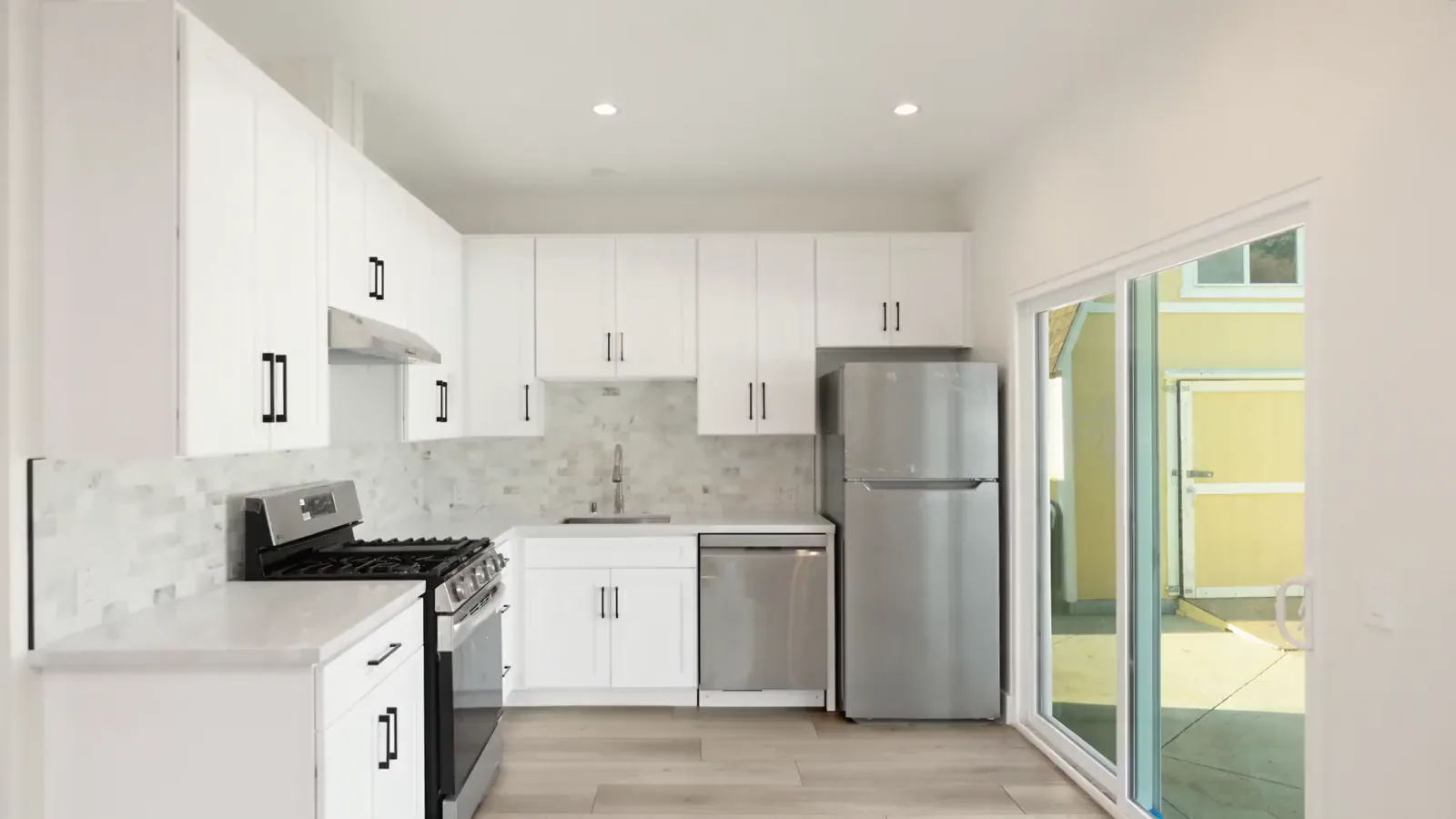
- 01 / 03The kitchenWhite shaker cabinets over a marble-look backsplash.
- 02 / 03StainlessA gas range, a dishwasher and a stainless refrigerator.
- 03 / 03To the yardA glass slider opens the kitchen to the yard.
San Juan Capistrano ADU Regulations
How to get a permitted ADU in San Juan Capistrano.
Avorino carries the city. Submission, plan-check corrections, and final inspection, all handled in our office, on your behalf. State law preempts city setbacks (4-ft floor) and starts a 60-day ministerial clock once the application is complete, so correction rounds delay when that clock starts.


01 / 04
Permitting
City of San Juan Capistrano Building & Safety Division. Avorino handles all submissions, plan-check corrections, and approvals on your behalf. You sign once at the start; the city correspondence is ours to carry.
- Verify homeowners association + zoning rules
- Pre-application consult
- Submit plans
- Plan check & corrections
02 / 04
Timeline
Design to Move-In From initial consultation to a fully finished, move-in ready ADU in your backyard.
- Consultation and site assessment
- Custom design and engineering
- City plan check: 4–6+ weeks, and longer once corrections come back
- Construction — typically 8–12+ weeks on a garage conversion; detached builds run several months, inside the 5–8+ month project window
- Final inspection and certificate of occupancy
03 / 04
Zoning
San Juan Capistrano Zoning & Setbacks San Juan Capistrano follows California state ADU guidelines.
- 4-foot minimum from rear and interior side property lines
- 16 feet for single-story detached ADUs
- Up to 1,200 sqft for detached units (per state law)
- No additional parking required if within 0.5 miles of transit
04 / 04
Investment
$85K – $440K+
Full design-build cost Architecture, engineering, permits, and construction — all included in a fixed-price contract.
- Detached ADU: $245K – $440K+ · 5–8+ mo
- Attached ADU: $200K – $350K+ · 5–8+ mo
- Junior ADU: $135K – $220K+ · 4–6+ mo
- Garage conversion: $85K – $170K+ · 4–6+ mo
- Permit + design fees: $6K – $15K+ typical · Impact fees waived at 750 sqft or less
- Rental income (Orange County range): $2,500 – $4,500+/mo, modeled on real OC long-term rents
Permit reality
How San Juan Capistrano plan check actually runs.
Two steps by design: Planning Division ADU Permit Review first, then building-permit submittal by scheduled appointment — with a free preliminary email review available before either. Historic-overlay parcels run a longer calendar; units of 750 square feet or less skip city impact fees.
- Submission is hybrid: email concept plans to Planning for the ADU/JADU review, then submit the building permit through an in-person appointment (booked via Acuity), with eTRAKiT used to track status. Avorino files both steps.
- Step 1: Planning Division ADU Permit Review; Step 2: building permit by appointment
- Preliminary plan review offered by email — we use it on every SJC project
- No city development impact fees at 750 sqft or less
- Historic Town Center / IHCL parcels: reviewed, slower calendar — designed for up front
- San Juan Capistrano offers pre-approved plans for prefab maker BOXABL — a single-family owner building a new detached ADU can use the city's pre-approved BOXABL design.
- Ordinance 1127 (April 2025) sets two review tracks — a streamlined Building Permit Review for conversions and qualifying detached ADUs; city impact fees are waived at 750 sq ft or less.
San Juan Capistrano ADU rules
The 2025 ordinance, the archaeology rule, and the quick facts.
San Juan Capistrano waives city impact fees on smaller ADUs, pre-approved a prefab design, and — as a mission town — puts an archaeological monitor on deep digs. These are the rules an SJC ADU actually runs on.
| Standard | What applies in San Juan Capistrano |
|---|---|
| How permits are filed | Hybrid: concept plans email to Planning for the ADU/JADU review, then the building permit submits through an in-person appointment (booked via Acuity), with eTRAKiT tracking status. We file both steps. |
| The 2025 ordinance | Ordinance 1127 (April 2025) sets two review tracks — a streamlined Building Permit Review for conversions and qualifying detached ADUs — and city impact fees are waived at 750 sq ft or less. |
| Pre-approved prefab | The city pre-approved prefab maker BOXABL's design — a single-family owner building a new detached ADU can use it to shorten review. |
| The archaeology rule | City Council policy requires an archaeological monitor on site during any excavation deeper than 18 inches unless the Planning Director grants an exemption — a real schedule item on foundation digs. |
| Utilities | Santa Margarita Water District — not the city — has been the water and sewer provider since 2021 (treated through SOCWA, not OC San), so every ADU needs a sanitation clearance from SMWD and the OC San capacity charge doesn't apply. |
Summarized from SJC's ADU pages, Ordinance 1127, and state ADU law; monitor and clearance requirements vary by project. Avorino confirms what your exact lot carries in the free consultation.
Lot profile
What San Juan Capistrano lots actually look like.
Historic-core parcels around the Mission and Los Rios with the county's deepest review; equestrian and ranch lots toward the hills with room to spare; and conventional tracts between them. The overlay map decides the calendar; the lot decides the design.
- Historic Town Center + IHCL blocks: deepest review in south OC — plan for it
- Los Rios district: California's oldest neighborhood — character compliance is the project
- Equestrian + ranch parcels: generous siting for detached units
- Standard tracts: conventional ministerial path on the 60-day clock
- Santa Margarita Water District — not the city — has been the water and sewer provider since 2021 (treated through SOCWA, not OC San), so every ADU needs a sanitation clearance from SMWD and the OC San capacity charge doesn't apply.
- As a mission town, City Council policy requires an archaeological monitor on site during any excavation deeper than 18 inches unless the Planning Director grants an exemption — a real schedule item on foundation digs.
- The city's building code requires a full soils report for all new construction including ADUs, and FEMA flood zones (AE) run along San Juan, Trabuco, Horno, and Oso Creeks (elevation certificate + raised floor there).
Verify with the city
All San Juan Capistrano ADU, custom-home, and construction details on this page, including fees, setbacks, timelines, and zoning, are based on the City of San Juan Capistrano Building & Safety Division's published information and are subject to change. This information may not be fully up to date or accurate. For the latest requirements, visit the city's building and planning department directly, and confirm anything that affects your budget or schedule before you build.
- Building authority
- City of San Juan Capistrano Building & Safety Division
- Official website
- sanjuancapistrano.org
See how every OC city & community takes ADU permits — the Permit Index
Official San Juan Capistrano ADU resources this page draws from
Investment range
Where Avorino's ADU budgets in San Juan Capistrano typically land.
Inland San Juan Capistrano ADU work tracks the OC average. Flat-lot construction, straightforward foundations, and clean utility runs keep build budgets predictable. Detached unit budgets typically land in the $245K–$440K+ range; attached and Junior ADU options trim significantly.
- Detached ADU:
- $245K–$440K+ typical fixed-price contract
- Attached ADU:
- $200K–$350K+ typical
- Junior ADU:
- $135K–$220K+ typical
- Permit + design fees:
- $6K–$15K+ typical
- Rental income (Orange County range): $2,500–$4,500+/mo, modeled on real OC long-term rents
How an Orange County ADU budget is built up, line by line — the same breakdown behind the San Juan Capistrano range above.
Recent builds
ADUs, built for real life.
Explore completed Avorino projects, photographed as built. Different properties, personal priorities, and ways to make a home.
01 / 08
Run your numbers
What would an ADU pencil out to in San Juan Capistrano?
Two free tools, calibrated to 2026 Orange County bids — a cost range in about a minute, and the rental return behind it.
San Juan Capistrano is one of 37 cities covered by our Orange County ADU construction service.
01 / Avorino in San Juan Capistrano
Does Avorino build ADUs in San Juan Capistrano?
Yes. Avorino builds ADUs in San Juan Capistrano. Detached, attached, Junior ADU, and garage-conversion ADUs handled end-to-end from permits through certificate of occupancy.
Is Avorino a licensed ADU contractor in San Juan Capistrano?
Yes. Avorino carries California General-B License #1107538 and builds ADUs in San Juan Capistrano end-to-end. With Avorino as the San Juan Capistrano ADU contractor on your project, design, engineering, permits, and construction stay under one roof, so the schedule and the outcome sit with one company, not a chain of subcontractors you'd manage yourself.
02 / Permits, time & cost
How does ADU permitting work in San Juan Capistrano?
Avorino handles all submissions, plan-check corrections, and approvals on your behalf. You sign once at the start; the city correspondence is ours to carry. The path: Verify homeowners association + zoning rules → Pre-application consult → Submit plans → Plan check & corrections.
What's the typical San Juan Capistrano ADU build timeline?
From initial consultation to a fully finished, move-in ready ADU in your backyard. City plan check: 4–6+ weeks, and longer once corrections come back. Construction — typically 8–12+ weeks on a garage conversion; detached builds run several months, inside the 5–8+ month project window. Avorino carries that schedule end-to-end, from permit submission through to certificate of occupancy.
What's the San Juan Capistrano ADU investment range?
Architecture, engineering, permits, and construction — all included in a fixed-price contract. Range: $85K – $440K+. That is an Avorino quote for your own lot, not a market average.
03 / San Juan Capistrano specifics
How does San Juan Capistrano's two-step ADU process work?
Planning reviews the ADU permit first; only then does the building-permit application go in, by scheduled appointment. The city also offers a preliminary email review of plans — a free early signal we use on every project here.
My property is near the Mission or Los Rios — what changes?
The Historic Town Center and IHCL overlays add review layers the rest of the city doesn't carry, and the calendar stretches accordingly. Materials, massing, and siting that respect the district's character pass faster — so that's how we design from sketch one.
Do SJC ADUs pay impact fees?
Not at 750 square feet of habitable area or less — the city waives its development impact fees below that threshold, which many one- and two-bedroom layouts fit inside.
How do I submit an ADU permit in San Juan Capistrano?
San Juan Capistrano is hybrid: you email concept plans to the Planning Division for the ADU/JADU review, then submit the building permit through an in-person appointment booked via Acuity, with eTRAKiT used to track status. The city offers pre-approved BOXABL plans, and Ordinance 1127 sets a streamlined review track for conversions and qualifying detached ADUs. Avorino files both steps.
Why does a San Juan Capistrano ADU need an archaeology monitor?
Because it's a mission town — City Council policy requires an archaeological monitor on site during any excavation deeper than 18 inches (unless the Planning Director exempts it), so a foundation dig carries that step. Water and sewer are Santa Margarita Water District (not OC San), every ADU needs a soils report, and creek-adjacent lots are in FEMA flood zones. Avorino schedules the monitor and carries the soils and flood work.
Talk To Us
Tell us about your San Juan Capistrano vision.
Drop the address and what you're picturing. We read it as soon as possible and come back with the strongest ADU type for your specific San Juan Capistrano vision, and what San Juan Capistrano permitting is known to throw at the project.
- 01Project
- 02Plans
- 03Context
- 04Contact
Nearby ADU markets
Other cities Avorino builds in.
Comparing ADU build options across the San Juan Capistrano corridor? Here’s the same end-to-end Avorino build, in the cities right next door.
Same city, other services
Avorino also runs these in San Juan Capistrano.
- Custom HomesBespoke residential, architect-coordinated.
- New ConstructionGround-up: site prep through Certificate of Occupancy.
- CommercialTenant improvements, retail, restaurant, office, ground-up.
- ADUDetached, attached, Junior ADU, garage conversion.
Service areas
Serving 37 Orange County cities & communities, plus unincorporated OC and nearby LA County.
- Aliso Viejo ADU construction
- Anaheim ADU construction
- Brea ADU construction
- Buena Park ADU construction
- Corona del Mar ADU construction
- Costa Mesa ADU construction
- Coto de Caza ADU construction
- Cypress ADU construction
- Dana Point ADU construction
- Fountain Valley ADU construction
- Fullerton ADU construction
- Garden Grove ADU construction
- Huntington Beach ADU construction
- Irvine ADU construction
- La Habra ADU construction
- La Palma ADU construction
- Ladera Ranch ADU construction
- Laguna Beach ADU construction
- Laguna Hills ADU construction
- Laguna Niguel ADU construction
- Lake Forest ADU construction
- Las Flores ADU construction
- Los Alamitos ADU construction
- Mission Viejo ADU construction
- Newport Beach ADU construction
- Orange ADU construction
- Placentia ADU construction
- Rancho Santa Margarita ADU construction
- Rossmoor ADU construction
- San Clemente ADU construction
- San Juan Capistrano ADU construction
- Santa Ana ADU construction
- Stanton ADU construction
- Tustin ADU construction
- Villa Park ADU construction
- Westminster ADU construction
- Yorba Linda ADU construction
- Unincorporated Orange County ADU construction
- Unincorporated LA County ADU construction