

Field notes · ADU
Orange County, CaliforniaField note · Orange County
How long does it take to build an ADU in Orange County?
Construction runs four to eight months or more by type. What decides your calendar is permitting, and the 60-day state clock is not what sets it.
Field note
About this guide.
- Subject
- ADU · Avorino
- Written by
- Avorino
- Published
- Updated
- Reading time
- 4 min read
Interactive estimate
Estimate your ADU cost
A 2026 Orange County range by type, size, and finish. Educational estimate — for a precise number on your lot, run the full ADU Cost Calculator.
Estimated cost
$285,000 – $315,000+
Ranges cover design, engineering, the permit process, and construction under one roof, for standard Orange County site conditions. City permit, plan-check and inspection fees are paid by the owner to the city and are not in these ranges, and neither are finish materials, landscaping or solar. Sloped lots, long utility runs, panel upgrades, and coastal or fire overlays can move the number. It is an educational estimate, not a quote or a promise.
The short answer
Construction itself runs four to eight months or more in Orange County, and which end you land on is mostly decided by what you are building.
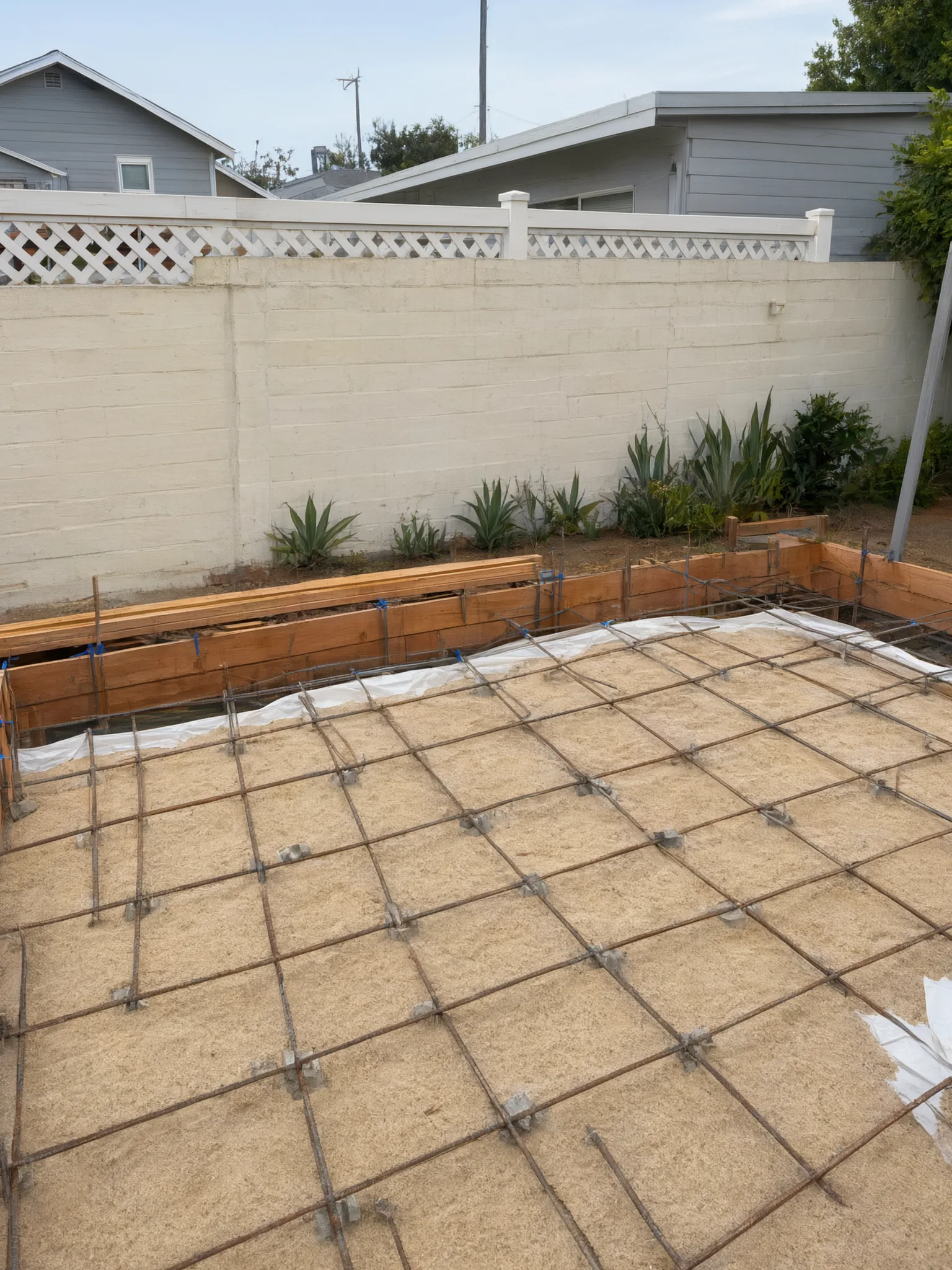
A garage conversion typically takes 4–6+ months. A Junior ADU, converted inside the existing footprint, also runs 4–6+ months. An attached ADU typically takes 5–8+ months, and a detached unit 5–8+ months, because it needs its own foundation, its own envelope and its own utility runs.
Those windows are floors rather than forecasts, which is what the trailing plus means. Then add permitting on the front of them, and permitting is the half nobody can hand you a number for honestly — not because it is mysterious, but because it depends on decisions that have not been made yet when you ask.
That is the useful part of the answer, and the rest of this explains it. Unlike the construction half, most of the permitting half is decided before anyone breaks ground.
The 60-day state clock is not your timeline
This is the part that surprises people, and it is the reason so many published timelines are wrong.
California gives a city 60 days to act on a complete ADU application. That sounds like a firm ceiling on your permit, and it is widely repeated as one.
It starts only once your application is complete, and the city meets it by acting — a correction letter counts as acting. When plan check comes back with corrections, the clock stops being the constraint — you are now on your own turnaround plus the city's re-review, and the cycle can repeat.
So the statutory clock is a limit on how long a city may sit on a finished package. It is not a promise about how long your permit takes, because most permits are not one finished package on the first pass. Correction rounds are what actually set the calendar.
That reframes the whole problem. The lever is not chasing the city. It is landing the first submittal complete enough that there is little to correct.
Plan check, and why the city you are in matters
Plan-check turnaround in Orange County commonly runs four to six weeks or more when the package is complete at intake, and longer once corrections come back.
Which city you are in changes the front of that in a way most timeline articles ignore entirely. Some Orange County cities take ADU submittals through an online portal. Others still want plans filed in person, on paper, at the counter — and at least one publishes a portal for minor permits that does not accept ADUs at all, which is exactly the kind of detail that costs a week if you find it out by turning up.
We publish what each Orange County city actually does, city by city, in the Orange County ADU Permit Index. It is worth two minutes before you plan around a date, because the filing method sets how quickly your package reaches a plan checker at all.
None of this changes the construction half. It changes when the construction half is allowed to start.
What actually compresses the schedule
Four things, in rough order of how much time they save.
A complete first submittal. This is the whole game. Every correction round is your response time plus the city's re-review, and it is the difference between a permit measured in weeks and one measured in seasons.
Choosing the typology honestly. If speed matters more than square footage, a garage conversion or a Junior ADU is structurally faster — no new foundation, no new envelope — and the canon reflects that with a shorter window.
Utilities settled early. Sewer, water and panel capacity are where a straightforward project turns into a long one, and they are knowable before design finishes rather than after.
And a realistic start date. Long-lead items and inspection availability do not care about your spreadsheet. A schedule with slack in it survives contact with a real plan-check queue; one built on best-case assumptions produces the same finish date, just with more stress attached.
Where these numbers come from
The build windows above are Avorino's own project ranges by ADU type, the same figures used across this site and in the cost calculator, and they carry a trailing plus because they are floors rather than promises: a specific site, a specific city and a specific scope can run longer.
The 60-day figure is California's statutory limit for a city to act on a complete ADU application, and the point made above about it is the operative one — it runs only while the application is complete.
The per-city filing detail comes from our own research into how each Orange County city takes an ADU submittal, published as the Orange County ADU Permit Index and re-checked against each city's own published process.
Plan-check turnarounds are typical ranges, not commitments. Avorino does not control a city's queue, and no builder who tells you otherwise controls it either. Timing on any specific project depends on the city, the completeness of the package and the scope.
More field notes
Keep reading.
01 ADU Construction in Orange County: What You Need to Know
- ADU
- 4 min read
- Written by Avorino
How ADU construction actually runs in Orange County: design, engineering, city plan check, and the build, with one accountable team end to end.
Read the guide
02 Housing affordability and Orange County’s ADU plans
- ADU
- 4 min read
- Written by Avorino
Orange County offers preapproved ADU plans. Learn what the program covers, what your application needs, and what to check before choosing a plan.
Read the guide
03 SB 1117 Lowers Impact Fees on ADUs Over 750 Square Feet
- ADU
- 4 min read
- Written by Avorino
California bill SB 1117 changes local impact fees for accessory dwelling units. See how the marginal fee calculation applies to units over 750 square feet.
Read the guide
Avorino builds this
From reading to building.
Same team, end-to-end
Want the answer for your specific project?

- 01Project
- 02Plans
- 03Context
- 04Contact